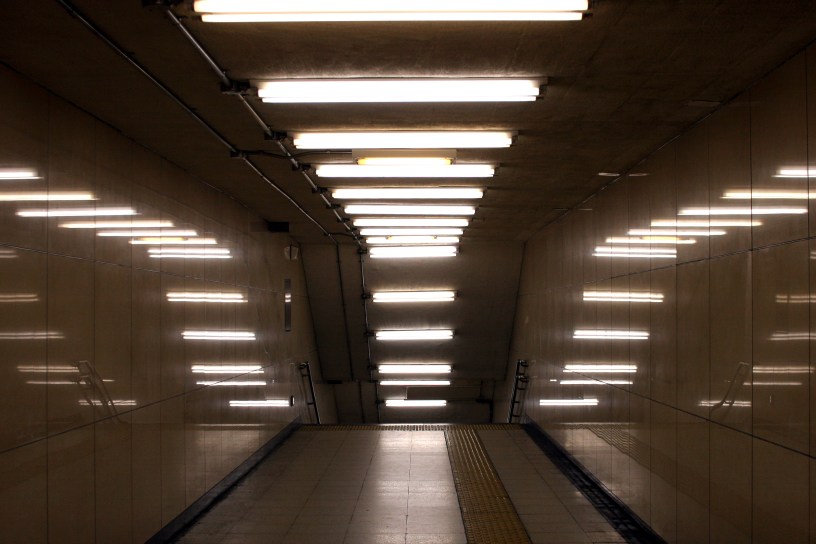
My brain condition is similar to epilepsy but in fact a form of migraine with both known and unknown triggers, the most common being long-tube or compact fluorescent lights and LED strip lighting.
Please note that I cannot meet, work nor transit through spaces with these lights, particularly older fluorescents that flicker at lower frequencies.
I conduct accessibility checks ahead of my every visit to every new place – for every meeting, every venue, every show, every hotel, every airport, every restaurant, every bar, every café, every social engagement, every home, every chore.
How to ensure accessibility
⚠️ Download and share interim safety procedure for The Capitol
- If your venue has inaccessible lighting and we’re switching it off for my visit, please cover all light switches with tape and a warning sign to prevent accidental activation
- If you’re replacing large banks of old fluorescent tubes, use LED tubes
- If you’re replacing single compact fluorescent bulbs, use halogens.
There’s also a range of less predictable triggers around lighting colour, colours of vertiginous contrast, and the impact of unexpected movement through such spaces, that continue to cause havoc for me; all part of the ongoing ad hoc experience of navigating inaccessibility that can have devastating consequences.
Because the impacts on my brain are at the extreme end, exposure triggers a response similar to epilepsy but sitting in fact on the migraine spectrum. Fluorescent lights (and most particularly, older long-tube fluoros with magnetic or electromagnetic ballasts, and compact fluorescents), LED strip lighting and other triggers interfere with the functioning of my brain to such an extent that they cause some mixture of pain, confusion, impairment of judgement, impairment of vision, impairment of speech, momentary loss of consciousness, petit mal seizure, and ultimately, migraine which can last for days.
Migraine is the sixth most disabling condition in the world. Thankfully, sensory and invisible disabilities are becoming better and better understood – but still there’s a long way to go. Here’s some useful information from the Australian Human Rights Commission on how to understand the rights of people with disability, and how to avoid disability discrimination.
About fluorescent lights and LEDs
Fluorescent lights produce light by ionising mercury vapour using an electrical current, creating short-wave ultraviolet light that makes the tube’s phosphor coating luminescent. The frequency at which fluorescent lights operate affects everyone’s brains to differing extents.
LEDs – light-emitting diodes – produce light by electroluminescence, an energy-efficient process that passes an electrical current through a semiconductor, operating at diverse frequencies that can also impact brain function. Single LED bulbs are relatively inert; LED tubes replacing fluorescents are commonly used in workplaces; LED strip lighting is used in decorative contexts outside of residential and workplace applications.
While LED tubes and high-frequency fluoros are transforming my world for the better, the frequencies emitted by LED strips are as hazardous as old fluoros. Given their variable colour properties, a new hazard is introduced by the inconsistent effect of lighting colour/warmth, and the impact of wall colours and other patterns on my brain’s reception of that light. So tiresome.
For me, the impact is to the brain, not the eyes, which is why blindfolds don’t work. There are overlaps between brainwave frequencies and the frequencies at which fluoros and LEDs operate, especially older fluoros. The impact is not about the brightness of their light, and nor do any casings or coverings make any difference; it’s about how they produce light, and how that interferes with the functioning go my brain.
Best practice
- If your venue has fluorescent lights and/or LED strips and we’re switching them off for my visit, please cover the light switches with tape and a warning sign to prevent accidental activation (this happens far more frequently that you might imagine!)
- If you’re replacing large banks of old fluorescent tubes, use LED tubes
- If you’re replacing single compact fluorescent bulbs, use halogens.
When fluorescents are switched on, the erratic blast they emit in the seconds it takes to reach their optimal frequency has a massive impact on my brain – like being exposed to them for over an hour.
Of course, all of this can be hard to explain and hard to understand. People without disability tend not to see lighting and forms of lighting. Most people’s brains process lighting and contrast without confusion or distress that can lead to migraine and seizure. Given the risk, thankfully there are global best practice standards in ensuring that emergency access spaces are always painted white, for example, to avoid introducing unnecessary hazards.
Astoundingly, even in today’s more understanding world when it comes to disability, there’ve been some absolute corker responses to accessibility enquiries. Two of my former EAs, the amazing Joanna Gould and Adelaide Fisher, have heard it all! At Regional Arts Victoria we had a particular example of the head of a cultural institution whose response has become the stuff of case studies: he refused to make accessibility modifications (simply switching the lights off in a room with abundant natural light), refused to meet me elsewhere (there was a café downstairs), and then on being told it wouldn’t be possible to meet under those circumstances, told Joanna that he’d keep the appointment in his calendar “and if Esther wants to turn up, she can.” Needless to say, we never met. (We have been kind enough to omit his name and the name of his organisation from our case studies.)
Joanna used to exclaim: “If you were in a wheelchair, would they expect you to bring your own ramp?!?” Even organisations who have known me for a decade or two forget about access far too often – not just about my requirements, but the need to have some kind of procedure for asking for, recording and acting on accessibility needs. I do my best to remain patient, but far too often, it’s deeply disappointing and humiliating to have clear accessibility requirements ignored, or worse, to turn up to a meeting and find that the space is inaccessible, despite all the clarity at our end and confirmations at theirs.
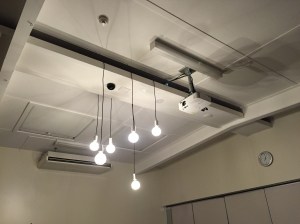
At the Colac-Otway Performing Arts and Cultural Centre (or just plain COPACC to locals) back in 2016, I experienced the most superb example ever of easy accessibility modification. Not only had light switches been covered ahead of our arrival, and not only did the venue staffer brief us on access and egress including toilets, but even more amazingly, the room we’d booked had the most delightful improvised lighting I’d ever seen (pictured left). A simple and very cost-effective approach that not only made the space accessible, it made us all feel welcome.
Everyone’s brain is different. Whenever I’ve changed jobs and had lighting modifications undertaken (it’s so easy now – you just replace them with LED tubes, plus you save so much on energy costs!), colleagues have remarked how much more comfortable they are, how much less likely they are to go home with a headache, how much clearer their eyes feel. Consider also that the operation of fluorescent lights in trams and trains is further disrupted by the irregularity of power through overhead contacts, affecting the brain in unexpected ways. What a relief that they’re on their way out; now we just need to get LEDs right.
Fluorescent lights have long been associated with sleep disorders, immune deficiency, depression, hormonal imbalance, anxiety and stress. LEDs also create havoc unless installed safely. Whenever you’re in a situation where you can control the lighting where you’re working, reading, thinking, moving or playing, do it: find what works best for you.
IMAGE: Older, large-diameter fluorescent tubes with magnetic ballasts. These used to be fitted in pairs in an attempt to minimise the effect of the flicker on the brain by complementing the frequencies. This rarely succeeded given the tubes do not age at the same rate. Attribution: “Fluorescent lamps artistic” by Flickr user Oimax. Image reviewed on 20 May 2007 by the FlickreviewR robot and was confirmed to be licensed under the terms of the cc-by-2.0. – Flickr. Licensed under CC BY 2.0 via Wikimedia Commons.
 ESTHER ANATOLITIS