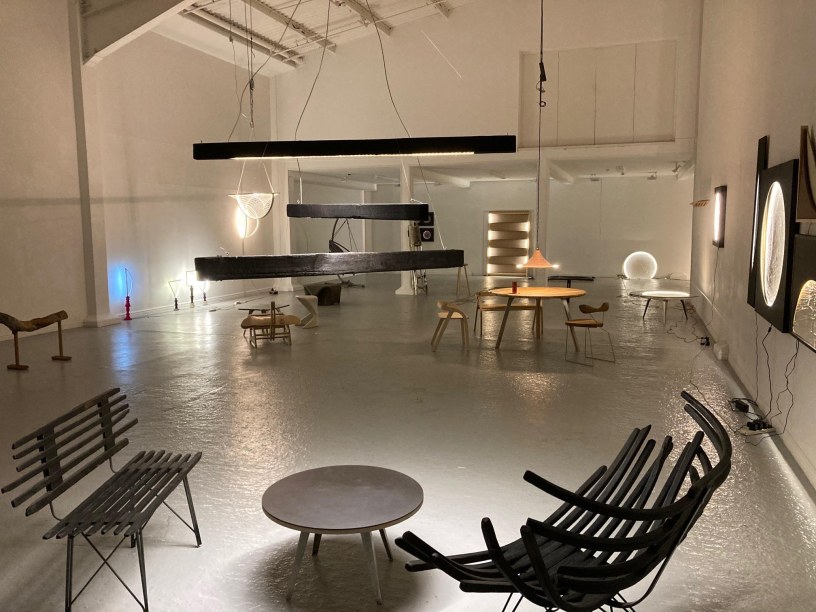
In framing Nick Rawcliffe’s exhibition, the title isn’t an explanation. It’s a playful little illumination of what’s to come – and, more than that: it’s an invitation.
Because there’s good work to be done here. Not the work of the designer, maker or artist we’re about to get to know; his work is already done. A Bit of Light Work is an invitation to put ourselves to work, exploring a set of objects whose possibilities can be revealed only by our bodies.
And how brilliant right now, isolated as we have been – I am writing from the other side of the world! – to take a moment just to be a body in a space… a space designed to welcome us with happy encounters among some seriously rigorous exploration.
A Bit of Light Work came about in the midst of the most debilitating cultural disruption of our generation. And yet it’s also been a time of reconnection and configuration. For Rawcliffe, this has meant focused studio time as well as focused home time, with the entire family of four having contracted the virus, including two little ones.
There’s nothing quite like existential threat to replace existential dread when it comes to motivating the creative process, and for Rawcliffe, it’s been a productive time. We’ve known each other twenty years, having worked together at the Bauhaus at the turn of the millennium, and ever since then it’s been an irregular yet deeply rewarding exchange. Speaking via video call, I enjoyed a personal tour of A Bit of Light Work – and it gave me a lot to think about.
Work and play
Putting ourselves to work is the promise of this exhibition – you feel it the moment you walk in. Rawcliffe’s renowned Hive and Circa Hanging Chair immediately draw the eye, welcoming elegant repose that draws the body away from the world to cocoon us in mid-air. The bold lines of Carbon Chair and the Carbon Bench invite us to reconsider the effect that geometric form can have on the body, surprising us with ergonomic comfort. The Hip Chair takes that invitation to another level, resetting our expectations around comfort and support to offer an experience that teaches us about our own bodies: the moment we sit, we start to feel and understand our posture, enjoying the tactile feedback, appreciating the contact points and what they tell us about our body in motion and at rest.
What our bodies are doing when we’re working or playing has long been an interest for Rawcliffe. Ergonomics for comfort; form as a kind of rigour. “The Hip Chair makes you sit correctly,” he explains, “because it’s really tactile – sculptural.” While working, we’re playing; while playing, we’re working, exploring, learning with different parts of our bodies.
That multi-sensory exploration and learning is one way to characterise experimentation, which is core to how Rawcliffe works and plays. A naturally curious thinker and maker, Rawcliffe delights in unexpected discovery: “You couldn’t design that in… Only when you make it do you realise that it can do that!”
Add the element of light and, well – it’s a whole new set of adventures.
Light and form
A bit of light work always sounds like a suspicious proposition… What’s really at play here? Working with light, Rawcliffe illuminates all sorts of quandaries, creating just as much clarity as confusion. Stringy Lights play such havoc with our perception that they cause our walking to speed or slow, our balance to shift. Elegant knottings of string generate Bézier curves – the string art we used to love as kids – and with Rawcliffe’s signature line of LEDs recessed into the frame, there are infinite ways to experience this work. “Every time you make something out of light,” says Rawcliffe, “you get something you’ve never seen before.” You can’t help but want to play with the rhythm of your movement as your eyes follow lines becoming curves becoming three-dimensional forms… and before you know it, you’re swaying, dancing. Your body has been put to work.
Add an element of illusion to an everyday object, and you’re transported beyond what your eyes are telling you is real. Fade, ostensibly a standard six-foot bookshelf, has you questioning your sense of reality with the flick of a switch. Shelves that a moment ago appeared parallel – that you know to be parallel! – suddenly skew, tilting perilously away. “It’s full-on Escher wonky!” Rawcliffe exclaims. A new take on the parallel lines illusion we’ve all been fooled by on paper, Rawcliffe shows us how easily our certainty can shift: “You can say, ‘I’ll believe it when I see it’ – well, you’ve just seen it, and it’s still not right!”
The relationship between light and form is among the most complex computations our brains are constantly making. What shape is that object? What colour? What if I could see it in a different light? Rawcliffe’s Flocking Bauhaus collection takes the triangle, circle and square, elevates them on a fancy little stand, and then makes their unique form disappear the closer they approach a wall: we see light of a specific shape take on the form of a warm glow of generic roundness. Conversely, his Hoop Light, an elegantly minimal form, makes bold triangles appear in strong, sharp shadows when rested innocuously in a corner. So is light a curve, or a straight line? Do parallel lines never meet, or do they always meet at some distant horizon? “Once your brain’s seen it, you can’t unsee it,” says Rawcliffe; “there’s no triangle – but there is!”
One thing Rawcliffe is very serious about is his rights as a creator, given the sorry state of intellectual property protections for artists and designers around the world. The “Shadow” light, which Habitat claims to have “designed in house” as an “exclusive”, has a remarkably strong resemblance to work that Rawcliffe has been creating and exhibiting for many years: “As much an art installation as a light,” Habitat assert, “Shadow makes a strong statement in any room.”
So is it design, or is it art?
There’s that peculiar question – one that only ever faces us in environments where objects are abstracted from their familiar context or purpose. We’ve already made the conscious decision to go and spend some time in a gallery; we’ve already opened our expectations and heightened our senses. We’re ready for art, for contemplation, and so we can be surprised by design, by form with function.
Typical of Rawcliffe’s approach, he makes light of the distinction between art and design, at the same time as he makes work of it. A bit of light work. “Is it that ‘art’ stuff, I don’t know… I mean, am I a designer, or what are these, or do they change when you put them in a gallery?” Again that challenge to us to make that distinction for ourselves, and to make it quite consciously as we play with the work.
“Lights are made to sit in one place, and do one thing, but you can muck about with these,” he laughs. Small-footprint experimentation is core to Rawcliffe’s ethos as an artist and his ethics as a maker. As a designer, he draws out what’s made possible by the materials he chooses, delighting in repeating forms across generative iterations, or into entirely new contexts. The strikingly cut form of his leather and metal Chess Set finds expression in the leg joint of the Spalted Beech Table; the elegant forms repeated in the Contour Shelf recall the disciplined forms of the Diddy Stool, the Tupac Chair and the Biggie Bench.
Then there’s the seriously artistic explorations of the lunar surface, the forms of micropollens and viruses, the various organic textures that can be enclosed by a circle of line or light. The moment they’re illuminated, that elegant closure of form immediately evokes the infinite – and right there is one of the greatest clues to the mind of this artist. Rawcliffe is never focused on just the one scale, on just the one material. Equal parts artist, designer, maker and inventor, Rawcliffe is always at work. What might emerge if those enclosed circles were expanded? Reconfigured? Re-illuminated?
Like Gordon Matta-Clark, Rawcliffe slices confidently through familiar form with works like Black Luna Eclipse and Luna Segment, revealing new depths for exploration. Like Salvador Dalí, Rawcliffe seeks structural form for natural objects in his Brench bench, and in doing so, takes them a little beyond the real, in the same way that Dalí’s repeated crutch motif makes us question the intentions of lifeless objects. And like James Turrell, light for Rawcliffe is a raw material among many, ready to be put to work in changing the form of an object, the depth of its reach, the scope of its impact.
“Imagine this at scale…” Rawcliffe wonders, “at Turbine Hall scale…”
What does light illuminate? What comes next in the logic from contoured form to human ergonomics and beyond? Where does the intricacy of organic texture go when it’s no longer contained? How many times over the past thousands of years has a maker, a designer, an artist captured the moon, only to become lost in its ever-expanding form? How often do scientists gaze into microscopes or telescopes and marvel as tiny rounded forms reveal entire ecosystems, entire galaxies? Does the enclosure of form evoke more of a sense of the infinite than its expansion at grand scale? What could happen if we all put our minds to it?
I don’t know about you, but I don’t mind a bit of light work.
A Bit of Light Work by Nick Rawcliffe
At Thames-Side Studios, Royal Borough of Greenwich, London
7-22 November 2020
IMAGE: Installation view.
 ESTHER ANATOLITIS